Category: power lift chairs
Posted by 2025-12-27 11:12
hoyer lift full body

Hoyer Lift Full Body: Core Value and Care Practice of the Full-Body Support Transfer System
In the modern care system for individuals with disabilities, the Hoyer Lift Full Body (Hoyer Full-Body Lifting System) is not merely a set of equipment, but a care philosophy centered on safety, dignity, and ergonomics. It is specifically designed for fully dependent users—those who cannot independently sit up, stand, or cooperate with transfers due to age-related frailty, spinal cord injuries, post-stroke sequelae, neurodegenerative diseases, or other conditions. Through the collaborative work of a full-body sling and a mechanical lifting unit, the Hoyer Full Body System enables smooth, painless, and dignified transfers in scenarios such as bed-to-wheelchair, floor-to-toilet, and bathtub-to-care bed.
This article will delve into the composition principles, target user groups, key operation points, and practical value of the Hoyer Lift Full Body in home and institutional care, helping caregivers understand why "full-body support" is not just a technical choice, but the most fundamental respect for life.
What Is the Hoyer Lift Full Body?
The "Hoyer Lift Full Body" does not refer to a specific product, but a complete transfer solution that uses a full-body sling as the core and works with a Hoyer Lift. Its core lies in "full-body weight support"—during the transfer process, the user’s entire body is supported by the sling, with feet off the ground, requiring no active effort or balance control.
This system typically includes:
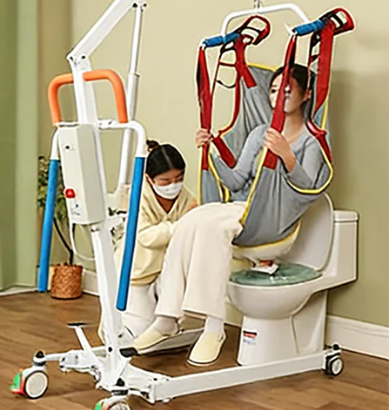
An electric or hydraulic lifting unit: Provides power for vertical lifting and horizontal rotation.
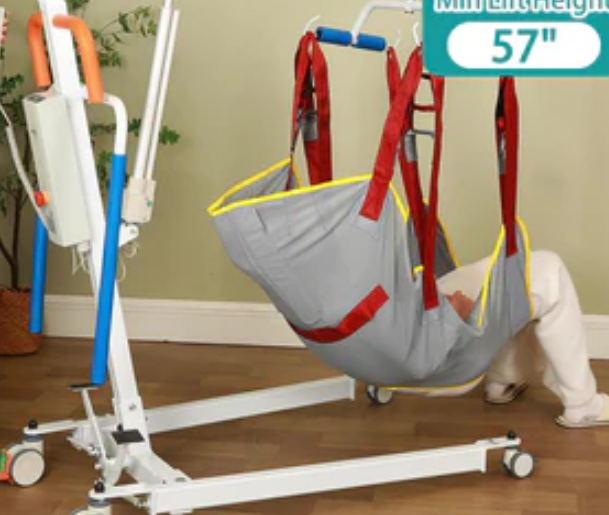
A full-body sling: Covers the back, hips, and back of the thighs to evenly distribute pressure.
A control system: A handle or remote control for precise start and stop operations.
An adjustable base: Adapts to different furniture layouts and space constraints.
Unlike partial support slings (such as seated slings or toileting slings), the full-body system is suitable for users with no weight-bearing capacity at all, and is the gold standard for care of individuals with severe disabilities.
Why Is Full-Body Support Necessary? — From Risk to Dignity
For fully dependent users, traditional manual lifting poses multiple hidden risks:
For caregivers: Bending + bearing weight easily leads to lumbar disc herniation and muscle strains, resulting in persistently high rates of occupational injuries.
For users: Dragging can cause skin shear injuries, shoulder dislocations, and even hip fractures.
Psychologically: Being lifted by multiple people, having disheveled clothing, and body exposure often trigger feelings of shame and helplessness.
The Hoyer Full Body System fundamentally avoids the above risks by replacing manual labor with machinery. More importantly, it makes the transfer process predictable, controllable, and private—users are no longer an "object to be handled," but an individual being gently supported.
Typical Application Scenarios of the Full-Body System
Bed ↔ Wheelchair Transfer
As a daily routine operation performed multiple times a day, the full-body sling ensures the user moves smoothly while suspended, avoiding shaking caused by height differences or winding transfer paths.
Emergency Response to Floor Falls
When used with a low-base lift and an extended sling, it can directly and safely lift the user from the floor, preventing hypothermia, pressure sores, or psychological trauma caused by prolonged stays on the ground.
Bathing and Toileting Assistance
Specialized quick-drying full-body slings or styles with openings allow transfers without removing clothing, balancing functionality and privacy.
Nighttime Turning and Posture Adjustment (Supported by Some High-End Systems)
Under professional guidance, it can assist in switching to a side-lying position to prevent pressure sores.
Core Principles of Safe Operation
Although the Hoyer Full Body System greatly improves safety, improper operation can still lead to accidents. Below are the key guidelines:
Strict size matching: An overly large sling is prone to slipping, while an overly small one causes discomfort due to pressure. The appropriate size should be selected based on height, weight, and hip width.
Correct wearing sequence: First help the user lie on their side, slide the sling under their body, then adjust the position of the leg straps to ensure no pressure is applied to the back of the knee creases.
Check connection points: Before each use, confirm that all sling loops are firmly attached to the lift’s hooks, with no twisting or misalignment.
Slow lifting and lowering: Especially when approaching the target position, operate at the lowest speed to avoid impact.
No overloading: The rated load capacity of the equipment must be at least 20% higher than the user’s weight to handle dynamic loads.
In addition, caregivers should receive basic training, understand the manual lowering operation in emergency situations, and perform regular maintenance on the equipment and slings.
Equipment Selection: Different Considerations for Home and Institutional Use
In home environments, users focus more on quiet operation, foldable storage, and ease of use. Although electric models are more expensive, they offer significant labor-saving advantages for caregivers living alone. Many domestic Hoyer Lifts (such as those from KDB and Yearstar) have obtained CE certification and provide cost-effective full-body transfer solutions.
In nursing homes or rehabilitation centers, durability, multi-user adaptability, and ease of disinfection are priorities. Institutions usually equip multiple sizes of slings (S–XXL) and establish sling cleaning and replacement systems to minimize the risk of cross-infection.
Regardless of the scenario, using original or certified compatible slings is an uncompromising safety bottom line. Mixing non-standard products may lead to connection failure and cause serious accidents.
Beyond Functionality: Safeguarding Human Integrity
The true value of the Hoyer Lift Full Body goes far beyond "moving a person from point A to point B." It allows an elderly person who has been paralyzed for ten years to be smoothly lifted to a wheelchair by the window in the morning to catch a glimpse of the sun; it prevents a patient with advanced ALS from shedding tears due to body exposure while using the toilet; it enables a daughter who has cared for her mother for years to finally sleep soundly without suffering from low back pain.
What this system conveys is respect for the integrity of the human body—even when mobility is lost, a person still deserves to be stably supported and gently treated.
Conclusion
In today’s world where aging and chronic disease burdens are increasingly severe, the Hoyer Lift Full Body System has become an indispensable infrastructure for high-quality care. It weaves a safety net with steel and fabric to catch every fragile yet precious life. Choosing and making good use of this system is not just a technical decision, but a reflection of care ethics: what we transfer is not "weight," but the person themselves.